
How to Read Your PrescriptionUpdated 2 hours ago
Prescriptions are written in shorthand, and the shorthand is not always explained when you are handed the page. Here is what each part means.
What Do OD and OS Mean?
OD is your right eye and OS is your left. They come from the Latin oculus dexter and oculus sinister. Some offices skip the abbreviations and simply write Right and Left, and some use OU for a value that applies to both eyes.
What Do the Columns Mean?
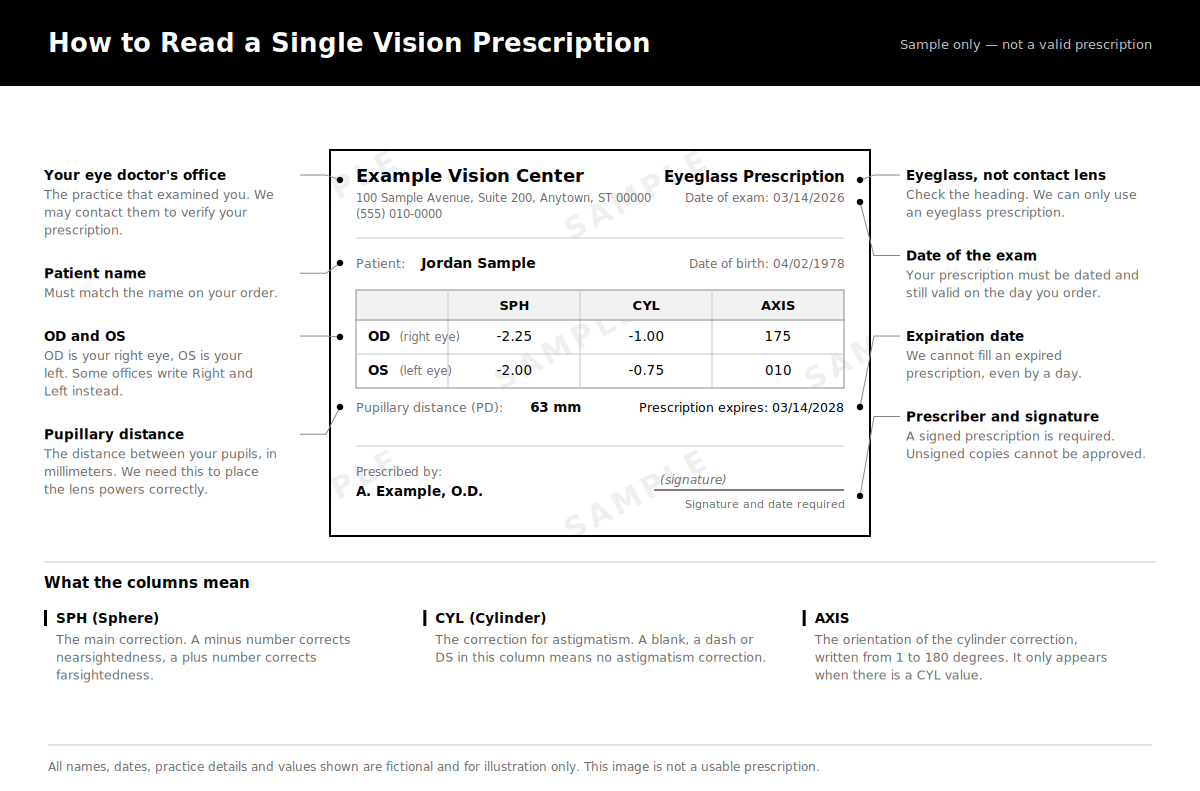
SPH (Sphere). The main correction, written in diopters. A minus number corrects nearsightedness, a plus number corrects farsightedness.
CYL (Cylinder). The correction for astigmatism. If this column is blank, or shows a dash, or reads DS or SPH, it means no astigmatism correction is needed for that eye.
AXIS. The orientation of the cylinder correction, written as a number from 1 to 180 degrees. It only appears alongside a CYL value.
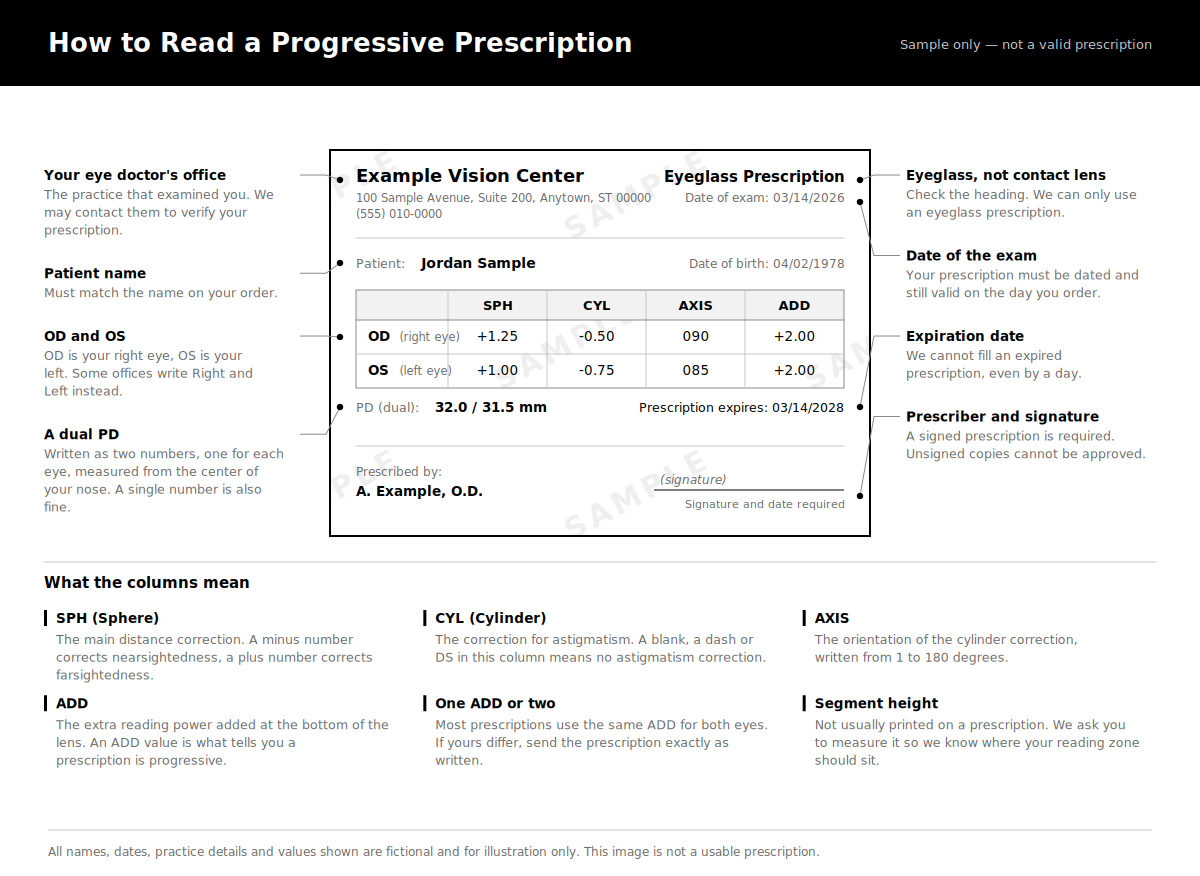
ADD. Extra reading power added toward the bottom of the lens. An ADD value is what tells you a prescription is for progressives.
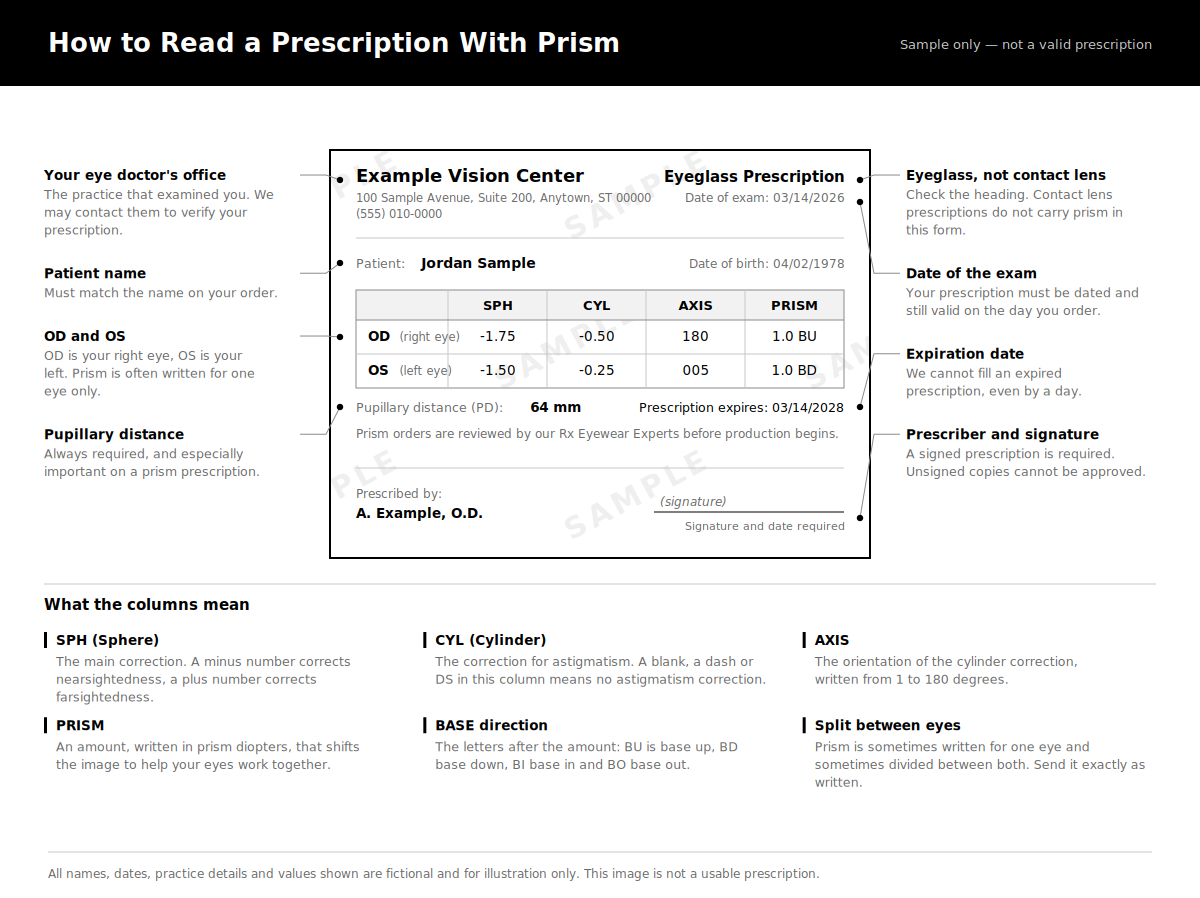
PRISM and BASE. A correction that shifts the image slightly to help your eyes work together. The base direction is written as BU (base up), BD (base down), BI (base in) or BO (base out).
What Does a Single Vision Prescription Look Like?
Here is a sample single vision prescription that includes astigmatism correction.
What Does a Progressive Prescription Look Like?
The difference is the ADD column. If your prescription has one, you have been prescribed progressives.
What Does a Prescription With Prism Look Like?
Prism is written as an amount followed by a base direction, and it is sometimes written for only one eye. Send us exactly what your prescriber wrote. If your prescription includes prism, place your order as usual and our Rx Eyewear Experts will reach out to verify the details before we begin.
Where Is My PD?
Pupillary distance is not always printed on a prescription, because it is a frame measurement rather than a vision measurement. If yours is not listed, you can measure it yourself or ask your eye doctor's office for it. See The Measurements We Need: PD and Segment Height for how to take it.
How Long Is My Prescription Good For?
We can fill a prescription written within the last two years, as long as it has not expired.
If your prescription lists its own expiration date, that date is the one that counts. Some offices write a one-year expiration, and when they do, we go by what is on the page. We cannot fill an expired prescription, even by a day.
What If I Don't Know My Prescription?
You do not need to remember it, but you do need a copy of it.
Ask the office that examined you. They are required to give you a copy of your prescription after your exam, and most will email or text one on request.
Check your patient portal. Many practices post prescriptions there.
Check the paperwork from your last pair of glasses. Prescriptions are often printed on the receipt or order summary.
Book an eye exam. If your last exam was more than two years ago, or your prescription has expired, a new exam is the only way forward.
One thing we cannot do is read your prescription off your current lenses. Even with the lenses in hand, a reading taken from a finished lens is not a substitute for a prescriber's written, signed prescription.
Still have questions about your prescription? Send a copy to our Rx Eyewear Experts and we will walk through it with you.